3 tips for incorporating more illustrations into your work

11/26/25
Education
3 tips for incorporating more illustrations into your work
we love a custom illustration moment. don’t you?
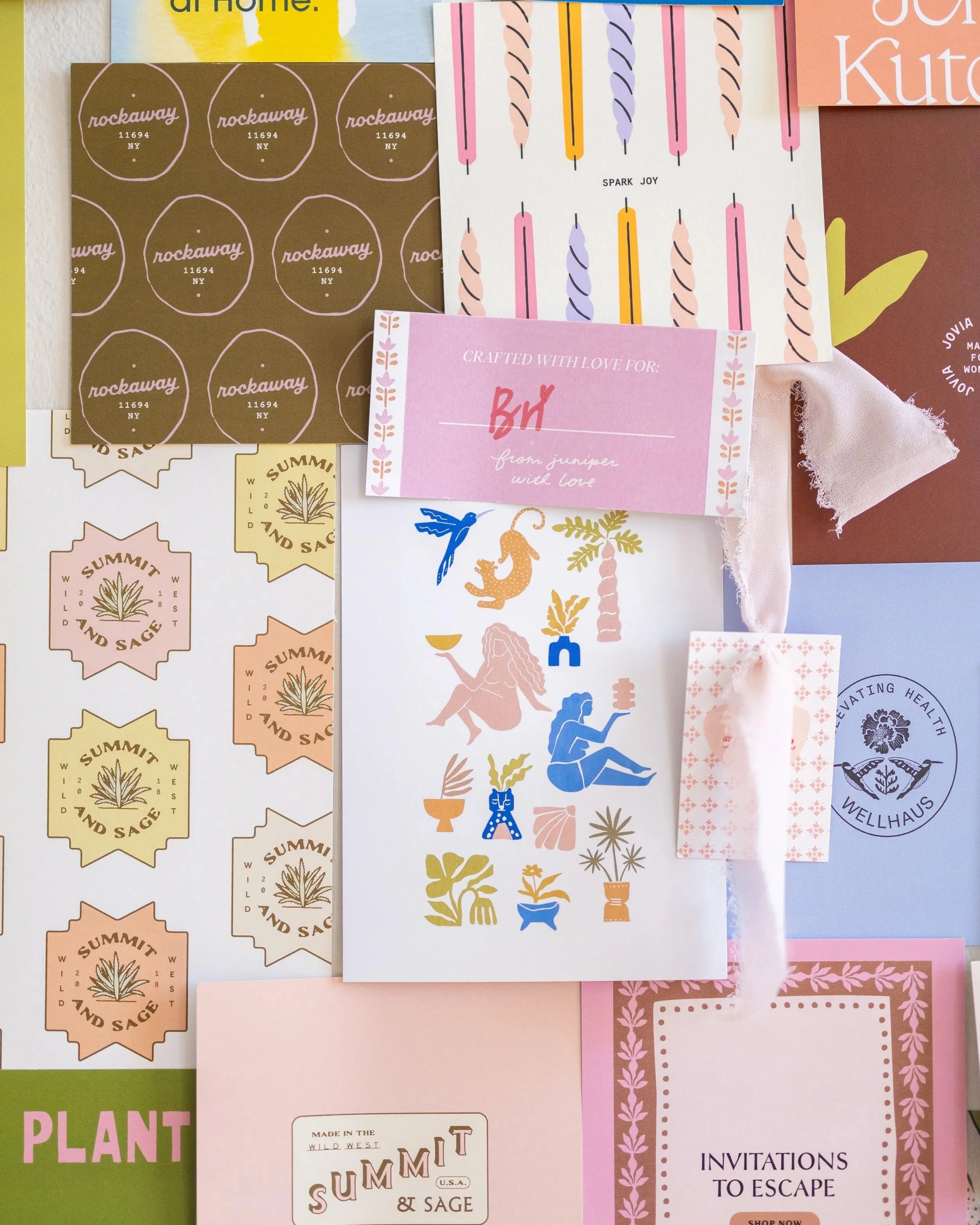
As a designer, illustration can be one of the key things to set you apart. If you’re new here, I’m a big fan of including icons, illustrations, or other artistic elements into all of our branding projects — and it’s easier to start incorporating these creative elements than you might think! I’m outlining three of my biggest tips below so you can start creating impactful work with more fun illustrative moments!
01 | Conceptualize
When it comes to illustration or any sort of graphic icon, I think it’s easy to assume everything needs to be literal. Let’s say your client is opening up an activewear brand for women. The illustrations you create don’t have to be an image of a girl running on a treadmill in a sports bra. Instead, consider what makes their brand unique.
For our client GNGR Bees, we integrated iconography that symbolized the lifecycle of their clothing and how their pieces were made out of recycled material. We used references to the moon, planet, and the bee, which all play a role in their brand story. Don’t be afraid to think outside the box and remember that the most memorable brands are often more abstract.
Psst — this is exactly the kind of conceptual thinking I teach inside BYND The Logo. Once you start using strategy to influence your illustration choices, everything you create becomes more intentional (and clients understand your work way faster).
02 | Decide the format
Choose whether your illustration needs to be vector or pixel-based. Think about the kind of style you’re going for. Does it need to be clean with sharp edges? What about a hand-drawn pencil texture? Color vs. outline? Refer back to your project’s goals and the vibe you’re going for.
We were taught in school that everythingggg needs to be vector when it comes to branding; however, I’d argue that most small, online businesses can get away with a few pixel-based patterns and elements here and there. As long as you’re not blowing it up on a billboard, you’re fine. If you need flexibility, I recommend using Illustrator’s image-trace feature to quickly vectorize any artwork, making it fully scalable for your client.
Inside BYND The Logo, I show you my full file-prep workflow for handing off illustrations, patterns, and branded elements in a way that looks polished and keeps clients from popping into your inbox with “um, hi, this looks pixelated?”
03 | Apply and explore
Fiiiinally, it’s time to bring the illustrations into your design project. For branding, we love to showcase how illustrations could be used as highlight covers across things like Instagram, or as visual references on a website to show how their product or service is unique. You could even take your illustrations and turn them into a repeatable pattern across tissue paper. In the words of Cady Heron, the limit does not exist.
And remember, you don’t neeeed all the fancy tools in the world to get started. I was incorporating illustration into my work years before I had an iPad Pro and Apple Pencil. It is by no means a prerequisite, but it can speed up the process. If you don’t have a fancy iPad, taking a photo with your phone next to a window, and then airdropping it to your computer will do just fine!
PSA: Designers
If you’re reading this like “okay yes, I’m ready to make my work look like a wholeeee vibe” you’d love my course BYND The Logo.
I teach you how to:
- build full brand identities (not just logos)
- incorporate illustrations + patterns into your systems
- present your work so clients trust your direction
- cut revisions way down
- feel like an actual creative director in your projects